Mark Cuban has an interesting post on his blog this week about how broadband video is overrated. As a lot of people who use the net know - video is very hot right now - especially on sites like YouTube.
As usual, he takes a very no nonsense approach to his argument and I must say he makes some great points that apply to distribution of movies and/or TV, etc.
Unfortunately, his outlook for the future of broadband video is pretty gloomy.
I hope he's wrong. I think (and hope) broadband video can be a huge boon for indie film distribution once bandwidth improves and more folks get used to the idea of downloading content versus renting (or buying) it from a brick and mortar store. As Apple's iTunes has proved (so far) people seem to like it.
What will the future hold? No one knows, not even Mark Cuban. But, I probably wouldn't bet against him...
-Blake
 Check out this article in the LA Times. It's slightly depressing for indie filmmakers trying to work their way up to the big time - but it's also reassuring (to an extent) as to why folks make movies independently...
THE real magic of Hollywood is not the knee-buckling resonance of a perfect screen kiss or the ability to conjure an army of Orcs from the plains of New Zealand. The real magic of Hollywood, as any agent, screenwriter, director, actor, producer or studio executive will tell you, is that movies get made at all. Especially now.
Some years back, a commitment from an A-lister, those actors or directors whose track records proved they could deliver a big opening weekend at the box office, usually guaranteed a big-budget project would get a green light. Then the formula changed — it often took getting a star to commit to the project and then trying to get them to cut their fee. But now, apparently, even that is not enough, as filmmakers on a variety of projects are beginning to learn.
So tell me again why I'd want to work in Hollywood?
-Blake
Been playing around with a few new poster looks...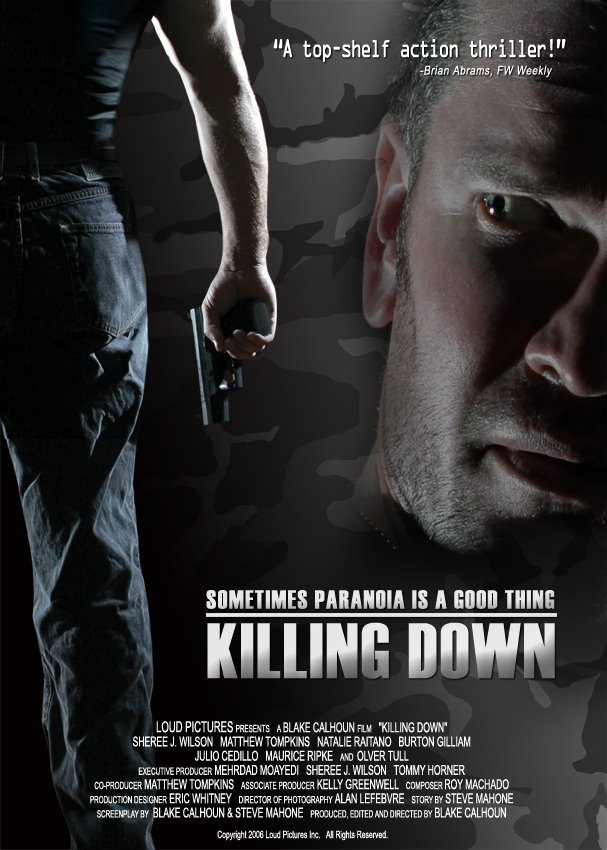
Working on alternative artwork for our upcoming industry screenings. I'm kinda diggin' this look myself. Do you like it?
-Blake
I keep hearing the term "cutting edge" about what we're doing with the post side of things with "Killing Down". This routinely surprises me too. We are finishing the film in HD, which to me seems like old news. Understand of course I don't mean it's not cool - it is very cool - but as much as I read about HD, etc. I don't feel what we're doing is that "cutting edge". However, I could be wrong... If you follow this blog (and the progress of "Killing Down") you know we're doing our final color correction as we speak. I was in Austin twice last week working with Omar Godinez and his boutique company Color Cafe (they hadn't done an HD feature until ours).
For our correction we decided to go with a "desktop D.I." using FinalTouch HD. "D.I." stands for Digital Intermediate - which is really used for filmouts today in Hollywood (and some indie projects) - but it's traditionally very cost prohibitive. However, FinalTouch HD has put D.I. in the reach of low budget indies like ourselves. Of course we're not doing a "true" D.I. because we're not going out to film and it's not at 2K resolution (not quite anyway, we're at 1920x1080 HD resolution - just shy of true 2K).
So far things are going fairly smoothly. There have been of course the normal hiccups along the way. Mainly dealing with PC to Mac translation issues. Since we are onlining the film in an Avid DS Nitris suite (running on Windows) and FinalTouch runs on a Mac (really working in conjunction with Final Cut Pro) we've had problems reading/writing back and forth to drives and getting our QuickTime codecs straight. There have also been issues with the EDLs and some timecode problems, but I think we're about to get all this figured out.
In the end, the color correction is what matters most to me. These workflow issues suck, but the final product is what is important. That's one of the main reasons we went with Omar - he has over 20 years experience color correcting.
But as much HD production that goes on out there it seems that most do not finish in HD. They downconvert to SD and then to DVD or whatever. So, all the HD post we're doing - and btw it's all uncompressed HD that runs about 120 MBs a second (that's 35 times larger than DV) - really might be "cutting edge"? Most people I talk to or try to get advice from have never done what we're doing.
I plan to post a real "tech geek" entry soon as to the exact workflow we used covering the entire post process from offline, to audio post, color correction and final online conform. It's been very interesting and a great learning experience, but I'd probably never do it this way again (the workflow that is, I've really liked the various software and gear we used).
So I guess maybe this is all "cutting edge" stuff? Or, maybe a lot of folks out there are just slow to catch on. :)
-Blake
As a filmmaker I must admit that piracy scares me. No, I'm not worried about being held up on the high seas by a pirate looking like Johnny Depp. I'm talking people stealing your copyrighted video/film content and selling it. Movie-piracy.
The music industry has been going through this for years and of course movie studios too have had major concerns. And with all the new HD content on it's way to the marketplace on DVDs, etc. it will inevitably happen even more and the thieves will have a "perfect" copy of the original work to duplicate (and sell). Pretty scary.
Another form of movie-piracy of course is simply videotaping a film in a movie theater. Evidently this is one of the biggest problems of all and last week the FBI broke up a big international ring and arrested 13 people.
Authorities estimate that 90 percent of the pirated, newly released movies that become available through bootleggers and on the Internet come from camcorder copies made in theaters.
Here's a link to the story in Reuters.
Just think if it were your hard work being stolen? Believe me, it's not a pleasant thought.
-Blake
 I haven't taken the plunge into Myspace yet, but I plan to for "Killing Down" (and maybe for myself showcasing my directing efforts).
I've of course known about it for quite a while, but haven't taken the leap because I used to think it was "only for teenage kids" and mainly geared towards music. While I still believe the vast majority of Myspace members are teenagers (and music folks), I do know a growing number of "grown-ups" using it and the new Myspace Film section looks interesting as well.
Anyway, I plan to have a "friend's list" soon, but in the meantime check Natalie Raitano's Myspace page at http://www.myspace.com/natalie_raitano.
She runs it in conjunction with a fan, so it's a legit deal. No 14 year boy from Ohio posing as Natalie. It's her and she replies to most postings.
-Blake
Well, I FINALLY got some more of the photos back from the after party of the movie premiere. We've had issues getting the pix from the photographers. We still actually have one photographer that is MIA - so, we'll have even more pix hopefully soon. In the meantime here are a few select shots...
Matthew and his fiance' Shauna (she plays "Lisa")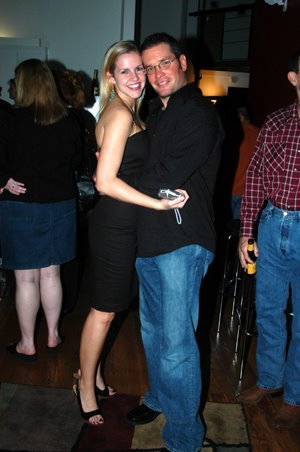
Natalie Raitano, Jimmy, Rachel, Rey and Nat's friend (can't recall her name!)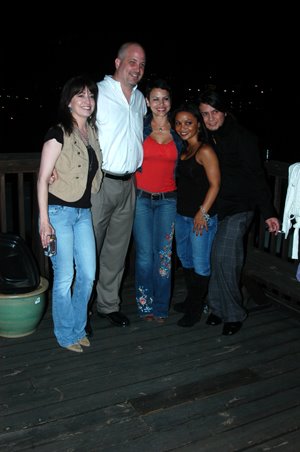
Oliver Tull with DP Alan Lefebvre and his wife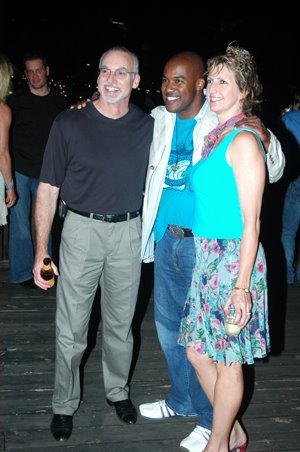
Jesse Cortez and Shauna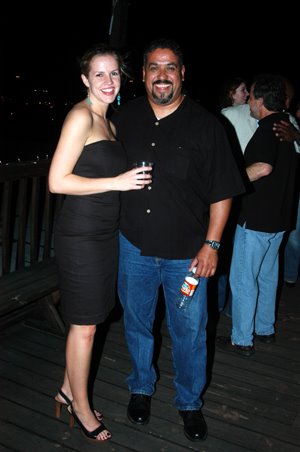
Natalie Raitano and Sheree Wilson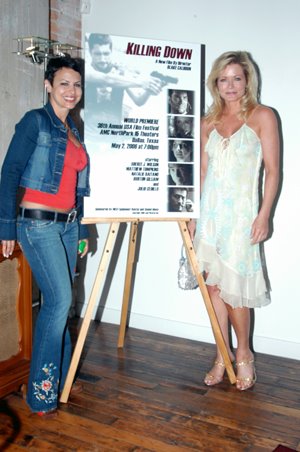
Jesse and Natalie
Sheree, Matt and Natalie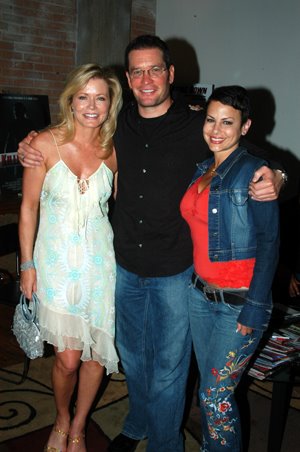
Natalie and Blake (yep, on the phone at the party)
Thanks to Jesse Cortez for getting me these pictures. As mentioned, I hope to have the last round of them up soon.
Oh, and the final version of the movie is ALMOST DONE. :)
-Blake
We're starting our final color correction and have done some test this past week.
We're doing what I'm calling an "indie DI" using FinalTouch HD at Color Cafe in Austin. Omar Godinez is the colorist (and owner of the company) and has over 20 years experience working at places like Filmworkers Club and Video Post & Transfer (both in Dallas).
Here's a quick sample of what we're doing...
Original Image: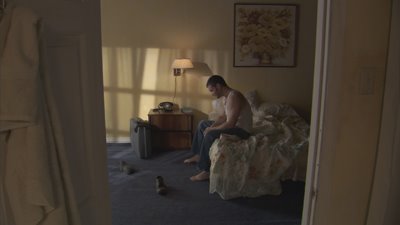
Corrected Image:
The original was shot very flat, low contrast with a lot of dynamic range knowing we would be doing color correction.
Pretty cool process and fun seeing it "come alive".
-Blake
 In the article below, Jacques Thelemaque of withoutabox.com has a different take than most today on the idea of using "stars" in independent films. He doesn't think you need them. He cites examples of successful films that didn't have them (or they weren't stars at the time).
This is all great and I really like his list of "facts" - BUT it's really all based in theory and unfortunately not the case in today's real world marketplace. For every "Napoleon Dynamite" success with "no stars" there are literally thousands of other "no star" failures.
Do stars actually help low budget indie films? Depends. If their performance is good, then yes, absolutely. If it's not good, then yes, absolutely. Why? It's all about getting attention for the work. Do I like this? Not really. But it is a fact.
We live in a celebrity driven culture and having a "star" in your film just gives it that extra "legitimacy" that some folks need (i.e. festival programmers, media outlets, distributors, etc.).
Here's Jacques article...
TIP OF THE MONTH: Avoid The "Star" Trap
I don't know how many financing and distribution seminars I've sat in on where filmmakers were sold on the importance of putting a "name" or a "star" in a film to make it more attractive to potential buyers/audiences. The logic of this is, of course, obvious. Until you break it down. Like much of the information (and people) orbiting around the filmmaking universe, the "star" thing is a superficiality embraced by the starstruck, naive, desperate and/or lazy filmmaker that doesn't hold up to substantive thinking.
Let me clarify that I am not saying there aren't benefits to having recognizable actors in your film. There are indeed. Many people in and out of the industry, including festival programmers, are star-obsessed. They put name actors on a pedestal and reward the film accordingly. But do you really want to pander to the "cult of celebrity" mentality? Especially when you do a cool-headed cost/benefit analysis (in terms of time, money, AND energy) of doing the "star" trip.
Fact #1: Very few stars can meaningfully affect a film's bottom line. Any distribution executive will tell you truthfully that there are very few actors that will significantly impact a film's potential revenue despite the widely held contrary notion. The film needs to be the star. The film needs to work.
Fact #2: Stars are hard to get. You can spend months, even years, trying to get stars interested in your project no matter how good your script is. Even if you figure out how to make contact, you are often sent from agent to manager to lawyer to publicist to dogwalker back to agent, and so on - with each one taking months to respond.
Fact #3: Stars can be expensive pains-in-the-ass. Even if you can get them to work for free (or practically free), they are still used to a certain level of treatment and perks that can wind up costing the production considerable amounts of money. Or, they just can't/won't meet the demands of your production - costing you more time, which equals money. Also, stars can often wield their experience and status to run roughshod creatively over a fledgling director and, in fact, over a whole production. Of course, there are many exceptions to this fact - known actors who are respectful and generous with their time and creativity. But there are many more horror stories.
Fact #4: Stars can upset the tone of a film. I don't know how many times I've been thrown out of the authenticity of a film by the sudden appearance of a recognizable actor - bringing with them the baggage of what we know about them from other stuff. I don't want to be lost in a film just to be pulled out when Paris Hilton shows up for a mise-en-scene-chewing cameo.
And really, what is a "star"? Or a "name"? Does it really benefit your film to have a world famous socialite or minor regular from a popular T.V. show (which is what most emerging filmmakers are lucky to have access to) in your film unless their acting ability truly benefits the film creatively? Answer: No. Instead reframe the whole star thing in your head.
First, make your film the star. Think of the film as a whole as the marketing hook that will attract investors and audiences. Your distinctive ideas and creative energy will "sell" the film. If you look at the Sundance successes over the past several years, almost none had "name" actors. From "Chuck and Buck" to "Blair Witch Project" to "Napolean Dynamite." Think of some the great films in world cinema history - DiSica's "The Bicycle Thief", Resnais' "Hiroshima, Mon Amour" or Lynch's "Eraserhead." Now, name the "stars" in them. Good luck.
Second, think in terms of casting the actor that will bring the most CREATIVELY to your film. Yes, there are plenty of "name" actors whose work you love and would be great for your film. If you can get 'em (and they won't make you pull your hair out), go for it. But always make the film, and the process of making the film, your priority in terms of deciding which actor is appropriate to cast. There are plenty of brilliant/and or perfectly appropriate actors for your film who are not "stars" or "names". Have the courage to champion them. Take advantage of their accessibility and collaborative energy. Keep your film authentic. Use them to make your film great and you will then have your "star."
Again, I completely agree with him in theory and wish it were the case. And I do definitely agree that cameos don't do much for a film. I also really like the idea of "making your film the star". But in today's marketplace it just makes sense to protect your investment by using at least a recognizable face, if not a "star", in one or more of the principle roles (if you can afford it and if the role is right for the actor).
Just use your head and don't cast the 60-year-old male cowboy "star" in a role written for a 25-year-old female lifeguard. :)
-Blake
Haven't posted anything in a while. Been busy trying to get final version of "Killing Down" wrapped up. Hope, I repeat, HOPE to have finished movie in my hand second week of July.
What do we have left to do?
1. A couple music cues and then the final sound mix
2. Two tweaks on two of the last VFX shots
3. Exporting all the HD reels for final color correction at Color Cafe in Austin (we're putting the footage on three 400GB Seagate firewire drives - it's just shy of 1.2TBs)
4. Once color correction is done, we'll re-import the footage back into the Avid DS to add the necessary effects and titles - then output the final movie to D5-HD tape.
I'll also make a simple version of the DVD (movie and trailer only) for marketing and giving to potential distributors. Plans are to arrange some industry screenings in LA and possibly NY in late July and into August.
If I've learned anything about independent filmmaking it's that everything always takes longer, costs more and doesn't go as planned - but that's what makes it fun too! :)
-Blake
Has anyone seen this?
http://kinooga.com/index.php?option=com_frontpage&Itemid=1
Basically you presell downloads to your film via Kinooga to actually finance the project. Similar concept to foreign presales, but on a smaller scale...
Kinooga lets you raise finances for your film project at any stage of its conception. You could be looking for development money for a script, looking for another few thousands bucks on an overspend, or simply trying to get the cash together to edit what you've already shot.
Interesting concept. My guess would be though there are a lot more people looking for money than there are people investing.
Check out their site for detailed info.
-Blake
 Brian Abrams of the Fort Worth Weekly called me last week requesting a screener of "Killing Down" to do a story/review of the film. I must admit I was hesitant because the film is NOT done and I prefer to put our best foot forward when we go out to the public. But, I did screen the movie at the USA Film Festival so it is in pretty good shape - just not completely finished (mainly the score, some visual effects, color correction and some final editing tweaks).
I decided to go ahead and send it to him warts and all, primarily to piggy back off the USA Film Festival screening and the press we received from that. So I sent it and here's a link to the review (it's at the bottom of the page).
I typically don't put a lot of weight on reviews - positive or negative - filmmaking is very subjective and so are audiences responses. I tend to fall into the camp of "any press is good press just as long as you spell my name right". Of course I prefer positive reviews and in this case Brian liked the work, which I'm happy to hear.
BTW, still waiting to get pictures from the photographers from the premiere and the after party. As soon as I get them I'll post them to the blog.
In the meantime, please check out the review and remember he saw a "work-in-progress" version of the film. :)
-Blake
Came across this info on the new HD Blu-ray DVD and thought it was useful...
What's the capacity of a Blu-ray disc?
A single layer 12 cm (4.72") diameter Blu-ray disc (BD) holds 25 gigabytes (GB) of data. A double-layer BD holds 50 GB of data.
Where does the name "Blu-ray" come from?
The name Blu-ray is derived from the blue-violet laser which is used to read and write Blu-ray discs. DVDs and CDs, on the other hand, use a red laser to read and write discs. The shorter wavelength of a blue-violet laser is one of the factors that enables more data to be written in the same amount of space versus a red laser.
What are the differences between Blu-ray and HD-DVD?
Capacity. Even though both use the blue-violet laser technology, BD offers greater storage capacity, 25 GB versus 15 GB for HD-DVD.
Support.
Blu-ray is backed by the Blu-ray Disc Association which has over 170 members. Companies included are Apple, DELL, Hitachi, Panasonic, Sony, TDK, 20th Century Fox, and Buena Vista Home Entertainment. HD-DVD is approved and endorsed by the DVD Forum, which includes over 230 companies. Some companies in the DVD Forum endorse both formats, but the major HD-DVD supporters include Toshiba, Memory-Tech, Microsoft, Universal Pictures, and New Line Cinema.
Structure.
The thickness of both Blu-ray and HD-DVD discs is the same, 1.2 mm. HD-DVD, like a DVD, is composed of two 0.6 mm substrates with the record layer sandwiched between them. On the other hand, a BD is composed of one 1.1 mm substrate and a 0.1 mm protective coating over the record layer. Therefore, the record layer (content layer) is brought closer to the laser in the BD enabling greater accuracy when reading the disc.
I'm now seeing ads on TV for release of Hollywood movies on DVD and Blu-ray. I'm not 100% sold on buying movies this way yet. Do I really want to buy all my favorite DVDs again? Do I want to spend $800 on a Blu-ray player? Pricing will come down, but I'm not so sure that downloadable movies won't be prevalent by the time they do. Then, you can just watch them on your computer OR your TV (and PSP or iPod) and not worry about a DVD.
I see more value in Blu-ray as a storage device for all kinds of back-up data (video, audio, etc.). But time will tell...
-Blake
 If you are in the film business it is VERY LIKELY you are familiar with the website IMDb.com a.k.a. The Internet Movie Database.
I personally visit this site all the time. I use it not only as a fan of other people's work, but as a tool to research films and primarily to research actors I'm interested in for future projects. This is one reason anyone who is an actor and has done any short film or feature film work should list their name on the site. Or, have the producer or director of the film you were in list it for you (they will be listing the project I assure you). It's actually very easy to do and a great way to get some publicity. AND, it's actually the main site that everyone (including Hollywood folks) use to look people up - from grips to actors to directors. If you are in the entertainment industry you should be on IMDb.
This brings me to the main point of this post. The NY Times has a really good article on the relatively unknown founder of IMDb. His name is Col Needham. I have been using the site for at least 8 or 9 years and I had never heard of him. All I knew was that the site originated out of England - and sure enough - that's where Col is from.
From the article:
As the founder and managing director of the Internet Movie Database, Mr. Needham might just be the archetype of the telecommuting Web-head. The site he founded and runs, http://www.imdb.com/, ranks as the 10th-most-popular entertainment spot online, according to ComScore Media Metrix. It had 18.6 million unique visitors in April, a 67 percent surge from a year earlier.
Internet Movie Database began in 1990 as a bulletin board database of movie credits. It was started by Mr. Needham and some film-buff friends. At the time, Mr. Needham was working as an engineer in Bristol at Hewlett-Packard (or, as he says in his native Manchester lilt, "Hewlett Pa-Cod") and had only a rudimentary strategy for financing the site.
"We didn't sit down and think, 'What's the best way to make money on the Internet?' " Mr. Needham said. "This is very much a labor of love. When we started the company, there was no commercial use of the Internet."
By 1998, the database had established itself as a favorite on the early Internet, and Mr. Needham was amused to receive a number of buyout approaches.
One was an invitation to a London hotel in January to meet with Jeffrey P. Bezos, the founder of Amazon. Mr. Bezos told Mr. Needham that he thought the movie database could help Amazon sell VHS cassettes and DVD's — Mr. Needham points out that it was in that order in those days — but also recognized that the site would need to be run separately to maintain its personality. Amazon, of course, could handle the technological end and pour resources into upgrades.
I didn't know that Amazon OWNS IMDb. I've always seen the links to Amazon, but they are very subtle. This might be changing soon though. In the article it mentions that Amazon might start using IMDb as a "front door" to their new movie download service that will allow users to burn their own copy of a DVD at home. Details are still being worked out, but there are several Hollywood studios involved. Sounds interesting for sure.
I just hope they keep IMDb the same. Without it no filmmaker or actor would have proof that they even existed (except of course their films, and they may not want to show them). ;)
Read the full article from the NY Times (you might have to register to read it).
-Blake
THE eternal question for us "outsiders" - by screenwriter John August:
http://johnaugust.com/archives/2006/how-do-i-break-into-hollywood
I love his ending quote...
So I’d ask everyone to disabuse themselves of the idea of “breaking into Hollywood.” It’s not like pledging a fraternity, losing one’s virginity, or pulling off a heist. It’s just getting a job, which is boring and real, and difficult enough without any inflated imagery.
Have a great Memorial Day Weekend!
-Blake
In all the films I've made - short films and feature films - there comes a point in the process where you have to decide if it is "done" - and this is a very subjective term.
One person's idea of a great film is another person's idea of something awful. That's one reason (among many) that making a good movie is sooooooo hard to do ("good" being subjective of course). Even the "best" films have parts people don't like. In the end you simply can't make everyone happy. So you just have to make the best film you can taking into consideration the opinions of folks you trust (by doing preview screenings early and often).
I just saw an interview with Ron Howard and Brian Grazer at Cannes where they talked about the fact that they didn't do any early public press screenings of "The Da Vinci Code" - or any public test screenings. The key word here is "public".
Ron Howard says he had at least 10 advance screenings of the movie - all done in private though - and several of them at his house for about 25 or so people. He would get folks he could trust not only to not talk about the film, but to relay HONEST opinions about the movie. Not sure how well this worked of course based on the early critical response to the film (although it's doing gangbusters at the box office).
We've only had one truly public screening for "Killing Down" (so far) and the response was very good. I did have three private preview screenings along the way for some key cast and crew - and we fixed several problems and made things better.
Getting feedack is crucial. But, you have to take some with a grain of salt. Again, it's all very subjective. Generally speaking, if I have at least three people say the same thing I'll take a look at it and likely change it. For instance, if three people say a scene is slow, I will often times take a look at it and tighten it up. Sometimes I won't. But I do listen to the feedback.
Right now "Killing Down" is not done in the true sense of the word. As mentioned in previous post - we're still finishing the score, sound design, a few visual effects and the final color correction. However, after screening the film (and showing it to a few other folks since then) I do feel I want to make the film tighter too.
So when is done "done"? Maybe never. Look at George Lucas revising "Star Wars" 20 years later. Heck, I'm considering adding a scene back into my last feature "Hit" for the DVD release we're doing later this summer (I'll speak to this in more detail in another post). But for "Killing Down"? I'm not sure. I just want the film to be as good as I can make it. Subjectively speaking of course...
-Blake
Still coming down from the high of the premiere at the USA Film Festival... it was a really good screening and I can't say enough how thankful I am to Mike Bird at MLD Equipment Rental and Doug Thompson at Sound Ideas for their help securing an HDCAM deck and a kick-ass 8000 Lumens DLP projector. Cool stuff!
The projector throw to the screen was 103 feet and the screen was just shy of 60 feet across!!! The HD held up great and it really looked amazing.
Funny thing - and I know for a lot of folks might already know this - but it's wild how much stuff you see on the big screen, especially in HD. I noticed all kinds of "imperfections" that on my 19" NTSC monitor I NEVER saw, and even on a 19" Ikegami HD monitor (a $15,ooo one at that) I really didn't see.
You always hear of Hollywood DPs and directors (and higher end indies too) wanting to screen their dailies and later their offline edits on the big screen and now I really understand why. It's just never been a real option for me. Best I've ever screened on the big screen is DigiBeta, even when we shot 16mm (it was transferred to DigiBeta). So standard def didn't really translate many bad things, but HD, woah... a completely different animal.
Okay, so to the update... we're just waiting on the last few VFX shots to be tweaked and then we're off to Austin and Color Cafe (colorist Omar Godinez's new company). We are doing a quasi-digital intermediate for our color grading using FinalTouch HD. Omar has over 20 years experience on the DaVinci and other high-end systems and has recently opened his own boutique shop using this new desktop software. I compare it to the way desktop NLEs have taken over and virtually eliminated the big linear online suites. One day the desktop DI suites will rule (and they're really starting to come on strong now actually).
The other thing we have left is the music. Our composer has a few more cues to create and then we'll do the final sound mix. This will be a lot of work (and a lot of fun though).
HOPEFULLY, these final things will be done in the next 4 to 6 weeks. Then our plans are to have an industry screening (or two) in Los Angeles for acquisition execs, etc. We'll post all future screenings here and on the main "Killing Down" website.
One other thing too - I should have more pix from the USA Film Festival screening and after party uploaded soon. I've had lots of request for more Natalie Raitano shots! :)
-Blake
I read this today and thought it was very well stated, and I completely agree with the idea. You only really learn about yourself through your failures. And you won't fail if you don't take risks....
From Jacques Thelemaque at withoutabox.com:
My suggestion to you can be summed up in a word - FAIL!
More precisely, give yourself permission to fail. As I've said in previous Enotes, the best way to create awareness for yourself as a filmmaker is by doing brilliantly distinctive work. And the best way to evolve to and exist in that space is to give yourself permission to fail. Like many of my comments, this plea to you may seem insultingly obvious. But I go to a lot of festivals and see a lot of films. Many are very professional, very competent, but very safe - been-there/done-that kinda work. While I often admire the production value in such films, there is nothing about them that allows me to remember one second of them (or the filmmakers who made them).
Those filmmakers need to embrace risk, and therefore, failure. They should, in fact, try to fail. Then there's no going wrong because if you fail to fail, you've succeeded. Make sense? Probably not, but you get the idea. Failure is part of life and especially inescapable in terms of invention - creative or otherwise. If you aren't failing, you aren't taking risks, and therefore not growing creatively. Also, the sense of creative freedom that giving yourself permission to fail gives you is immensely satisfying in and of itself.
And how do we come to a consensus definition of failure? We don't. One person's failure is another's stroke of genius. Creative failure is simply whatever isn't working for YOU after you've tried it out, which gives you the opportunity to learn from it, clean it up or try something new - perhaps something even more daring and exciting. There are so many of you filmmakers out there with jaw-dropping skill that once that skill is married to the original ideas that embracing failure will bring to you, your films will be, quite simply, AMAZING!
Again, I totally agree with this and highly suggest taking creative risks!
-Blake
Take a moment to read the diary entries from Coppola on the website for his new film (first film he's done in NINE years)...
http://www.ywyfilm.com/
This takes you to the home page. From there click on "Diary" at the top of the page, and then you'll see his several entries.
Interestingly, this is not about the making of the film or really even about the film. It's about youth and how some artists never live up to the great work they did when they were young.
He mentions many folks, but he's obviously referring to himself too. He gets a pass though (for his later work) in my book when you have The Godfather, The Godfather II, The Conversation, and Apocalypse Now on your resume. :)
One guy he doesn't mention that came to my mind is Orson Welles?
From his site:
I've been thinking about what seems to be a repeating pattern: artists who distinguish themselves when they are young, and then never can quite reach those levels again. There are many examples, especially in literature, the theater, and of course in film.
...I've begun to think that the only sensible way to deal with this dilemma is to become young again, to forget everything I know and try to have the mind of a student. To re-invent myself by forgetting I ever had any film career at all, and instead to dream about having one.
Go ahead, click the link above and read the entire thing. It's good.
-Blake
Cool story from Yahoo about a movie theater in San Diego that is showing ALL their movies this weekend DIGITALLY. Even the new "Mission Impossible III". That's pretty impressive and very exciting...
UltraStar Cinemas -- the first and largest theater chain in the nation to be 100 percent equipped with digital cinema capabilities -- marks another industry milestone this Friday, May 5, with the digital release of Paramount Pictures' "MISSION IMPOSSIBLE III." UltraStar's TownGate 8 in Moreno Valley, CA, will become the first in the world to have all screens showing films utilizing digital projection.
Read the entire article (reads more like a press release in reality, and it probably is):
http://biz.yahoo.com/bw/060502/20060502005849.html?.v=1
-Blake
If you work in the Texas film business (or would like to or have thought about shooting here) on either side of the camera take a minute to check out this new organization - they need people to register and help spread the word...
TEXAS MOTION PICTURE ALLIANCE
http://www.txmpa.org/
(from their website)
Statement of Purpose
An organization of organizations, The Texas Motion Picture Alliance (TMPA), is currently being formed to significantly bolster and expand the existing infrastructure of the film/video production industry in the State of Texas. Its purpose is to support the creation of financial incentives to producers of all such media both from within and outside of the state.
The organization intends to accomplish this via funded legislative means as a result of the combined efforts of all subsequent participants in the TMPA. The potential gains to be realized by the Texas economy in establishing such incentives will amount to hundreds of millions of dollars and their impact will touch virtually every sector of business within the state.
Regional Meetings and the Statewide Leadership Meetings are being organized and will be opened to the officers, board members and designated representatives of ALL organizations that stand to benefit for the objectives of the alliance.
Each area film commission or appointee by the Texas Film Commission will organize Regional Meetings. These will precede the Statewide Leadership meeting so that all will be better prepared for the task at hand.
The seven regions are currently:
a) Austin
b) Dallas
c) El Paso
d) Houston
e) Rio Grand Valley
f) San Antonio
g) Texas Panhandle
This might sound kinda boring to you and very "business like", and well, it is. Remember of course that it's called "Show BUSINESS" and this is what really makes a film a reality.
All this stuff is very important to the future of filmmaking in Texas and actually the Texas economy in general, so please take a look and register if you want to help out.
I'll try and get more details soon too to further explain what the organization does and how you can help.
-Blake
Interesting story from Wired covering a panel at the Tribeca Film Festival callled "Downloading at a Theater Near You". The main panelist were Steven Soderbergh and Todd Wagner (who I blog about often).
"The economic model of the film business is broken," said Oscar-winning director Steven Soderbergh during a panel discussion Monday night...
"We learned this from the music industry -- you've got to give the people what they want or they'll figure out how to get from other means," Wagner said. "People like Steve Jobs (now the largest shareholder at Disney) will turn one revenue stream into three revenue streams. We need to rethink and get creative about how to exploit revenue streams in the digital (filmmaking) world."
Read the entire piece:
http://www.wired.com/news/culture/0,70795-0.html
-Blake
Here's the first round of pictures from the festival screening and the after party. More to follow soon....
Natalie Raitano and Sheree Wilson in the theater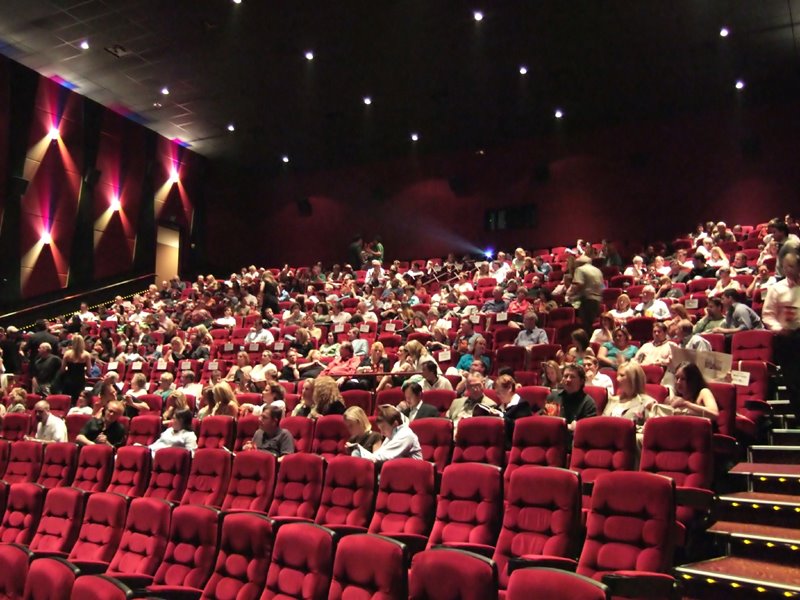
About 25 minutes before screening in the 500 seat theater (picture doesn't do much justice - it was a HUGE theater)
Julio Cedillo and Oliver Tull before the screening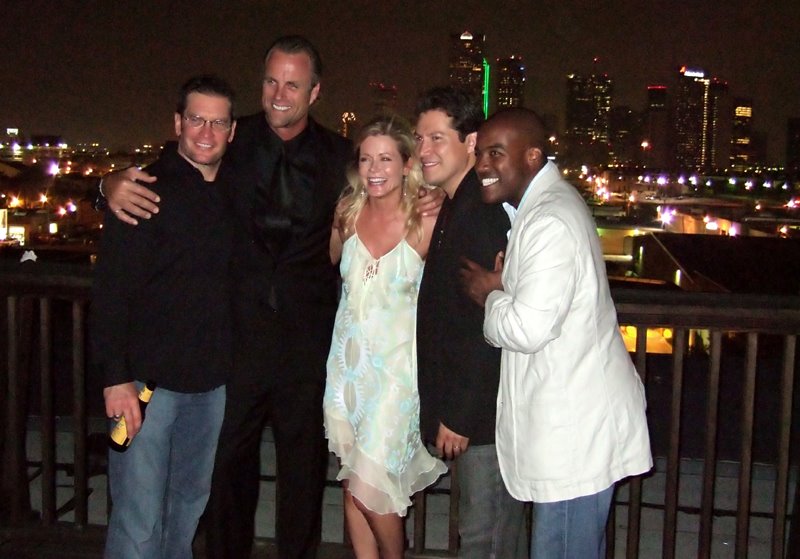
From L to R... Matthew Tompkins, Brett Miller (Sheree's boyfriend), Sheree Wilson, Julio Cedillo and Oliver Tull at the after party on the rooftop near downtown Dallas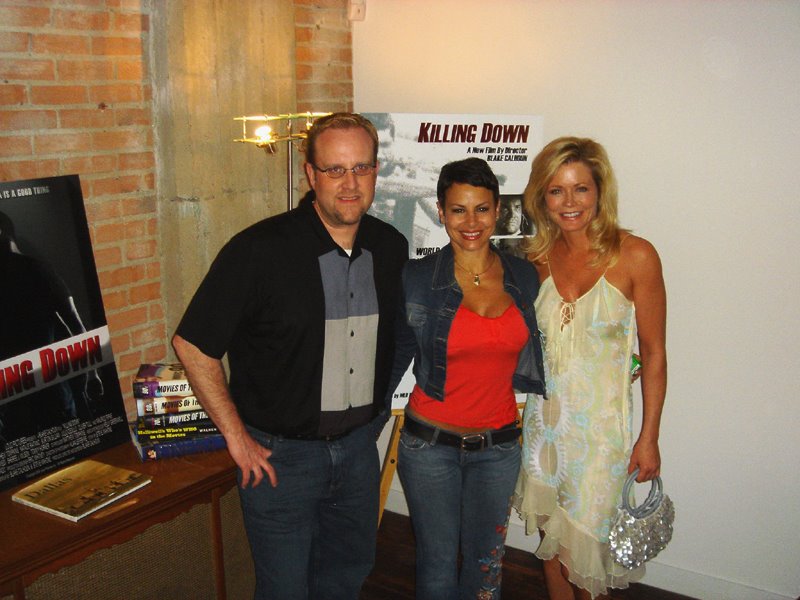
From L to R... Blake Calhoun, Natalie Raitano and Sheree Wilson in the loft at the after party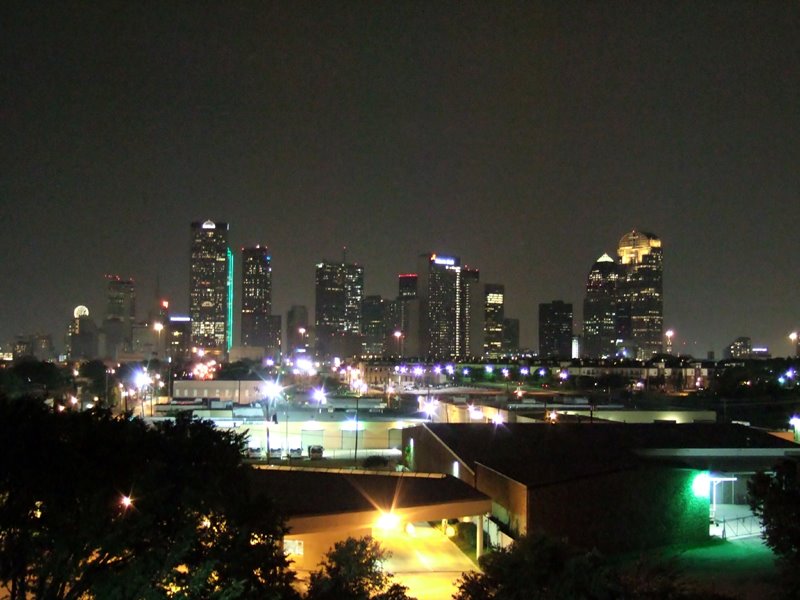
View of downtown Dallas from the rooftop after party
From L to R... Mara, John (friends of mine) and Natalie Raitano
More pix will be uploaded over the next several days...
-Blake
The premiere went great last night. Thank you to everyone who attended the screening. The 500 seat sell-out was incredible!
I'll post pictures and some press soon from the event.
If you didn't make the screening, we will be taking the movie to Los Angeles sometime in the near future. I'll post info on that as well.
Right now, I gotta get some rest. I'm exhausted. :)
-Blake
 This is the promotional poster we're using for the film festival.
Of course we're using the real poster too, but this one shows the principle cast and is really more of an announcement...
-Blake
The USA Film Festival screening of "Killing Down" has sold out with PRE-SHOW SALES VIA TICKETMASTER. I can't thank everyone enough for your support.
Based on the strong sales, the festival is now moving us into the largest theater that seats 500 people. So, they are releasing more tickets today. Please see my previous post on how to order. Great news!
Looking forward to next Tuesday...
-Blake
 I went and scouted the new AMC Northpark 15 theaters today and here's the deal with parking, etc:
Northpark Mall is in Dallas near the intersection of N. Central (75) and NW Hwy. BUT, just slightly north of Northwest Hwy is Park Ln. and this is the best way to get into the complex and find the theater.
Park on the north side of the mall between Nordstroms and Foleys (off Park Ln.). In between these two anchor stores is a small parking area (If this lot is full just park out a bit further) and a group of main mall entrance doors (right next to the new Kona Grill). Enter here and walk into the mall. In front of you you'll see a giant red sculpture - you are almost there. Take the escalators up to the second floor and go right. Straight ahead from there you'll see the AMC theater ticket windows. Pick up your tickets and then proceed up another set of escalators (to the left of the ticket windows) to the third floor to find the actual theater.
That's it. Movie is supposed to start at 7:00pm. So I'd try and get there at least 30 minutes early.
Also, I heard a rumor that the tickets are going very fast. So I've been told to warn folks that it will very likely be a sell-out. Buy your tickets NOW or you may not get to attend the screening.
Call Tickmaster at (214) 631-2787 to order your tickets.
I have no control over the ticketing or the seating. This is all done through the USA Film Festival. So, basically, don't bitch at me if you don't get a seat! :)
-Blake
Evidently, the Ticketmaster website is not selling tickets (yet) for the film festival. But, you can definitely buy them on the phone...
Okay, so here's the scoop for now:
TO BUY TICKETS FOR THE USA FILM FESTIVAL SCREENING OF "KILLING DOWN":
Call (214) 631-2787 and wait for a live operator.
Then say you'd like to buy tickets for the USA Film Festival screening of "Killing Down" on Tuesday May 2nd at 7:00pm.
Don't know when website purchase will be available, BUT as soon as it is I'll post a direct link.
Thanks!
Blake
UPDATE: Looks like Ticketmaster WILL NOT be selling tickets online for the festival. Yes, I know, this is ridiculous. I have no control over the ticket sales. So, unless something changes, please just buy tickets by calling the number above (if it does change I'll post another update). Tickets will also (assumably) be available at the box office the night of the screening. But, I'd suggest buying them in advance if possible. Hope to see you at the premiere!
Two interesting bits from the CinemaTech blog (these are copied exactly from it)...
----------------------------------------
- The LA Times observes that the porn industry often deploys new technologies that later get adopted by the mainstream media players. In this case, they cite movies purchased and downloaded from the Net that can be burned onto a DVD. (A hard drive, after all, can only store so many movies.) Claire Hoffman and Dawn Chmielewski write:
Hollywood has resisted burnable discs that can be watched on televisions because they fear piracy. It also doesn't want to alienate retailers, which sell most of its DVDs. But if history is any guide, the online experiment by adult entertainment giant Vivid Entertainment Group will be watched closely by mainstream studio chiefs.
"The simple fact is porn is an early adopter of new media," said Paul Saffo, director of the Institute for the Future in Palo Alto. "If you're trying to get something established … you're going to privately and secretly hope and pray that the porn industry likes your medium."
Los Angeles-based Vivid will start selling burnable movies May 8 through online movie service CinemaNow. Marina del Rey-based CinemaNow last fall launched an adult service that it uses to experiment with features that might eventually become mainstream — such as pay-per-minute movie rentals and the ability to save favorite scenes.
Vivid, producer of such titles as "Bad Wives" and "Generation Sex," will offer 30 downloadable videos for about $19.95 apiece that include everything that is on a standard DVD — cover art, scene navigation, bonus material and deleted scenes. The finished disc will be copy-protected to deter piracy.
Also...
Kodak's profit margins on the film stock it sells in Hollywood have always been high. One way the company could've helped to stave off the arrival of digital cinematography, a number of people have suggested to me, was by dropping its prices, while still earning a profit.
That would've ensured that shooting on film stayed (relatively) competitive with shooting on digital videotape, and made it an easier choice for everyone to preserve the status quo.
But now Kodak is doing the opposite, raising prices on motion picture film 3 to 5 percent, because of higher costs for raw materials and transportation.
Incidentally, Kodak executives will still tell you that they can't envision a day when film is no longer used in motion picture production...
----------------------------------------
-Blake
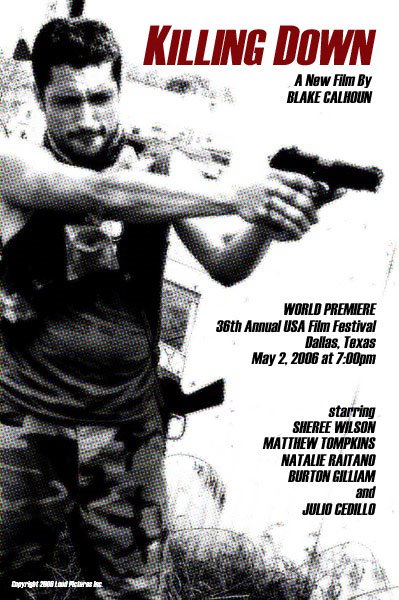 Well, it's finally here...
"Killing Down" will WORLD PREMIERE at the 36th annual USA Film Festival in Dallas, Texas on Tuesday May 2nd at 7:00pm.
Ticket info has not been announced, but the theater location will be the brand new theater at North Park Mall in Dallas. The USA Film Festival will be the first movies shown there! More info to follow soon...
UPDATE: Tickets go on sale through Ticketmaster on April 18th. So buy them early to guarantee a seat!
UPDATE #2: Well, it's Wednesday April 19th and tickets still are not on sale YET through Tickmaster. As soon as they are I'll post a message with a direct link for purchase. Please stand by...... :)
-Blake
 We're almost finished with all the looping for "Killing Down". Last week we had Sheree Wilson come in from LA to do her work. She's a seasoned pro I gotta tell ya. She NAILED her stuff - usually in one take - and it sounded great. Her years on "Dallas" and "Walker" sure helped in that regard.
Also, on one of her first feature films called "Crimewave" she had to loop the ENTIRE MOVIE. The director Sam Raimi (of "Evil Dead" and "Spiderman" fame) had wind machines blowing on the actors for a lot of the film, so none of the production audio was usable. They ended up looping all their lines later and so she got a lot of practice.
Anyway, Sheree was great and now all we really have left is Matthew Tompkins. We're waiting on him to get back to Dallas from NYC where he's finishing up his theater run. He's back in town on April 17th. It's definitely cutting it close though. The movie premieres at the USA Film Festival on May 2nd!!!
-Blake
Went to NYC a week ago with my girlfriend and saw Matthew Tompkin's off-Broadway show "Transatlantic Liaison". Matthew of course plays the lead role in my new film "Killing Down".
I hadn't been to NYC in over 10 years... hadn't changed much minus the World Trade Center Towers being gone - that was definitely weird to see in person - but the city is still alive and well. I forget how darn busy and crowded that place is. We had a lot of fun though. Ate some great food. Did some shopping. Drank some too.
I do enjoy experiencing that lifestyle ever so often, but of course as they say - it's a nice place to visit, but I wouldn't want to live there.
Times Square after midnight - we couldn't get a cab!
Matthew (L) and me outside the theater (no, I didn't smile).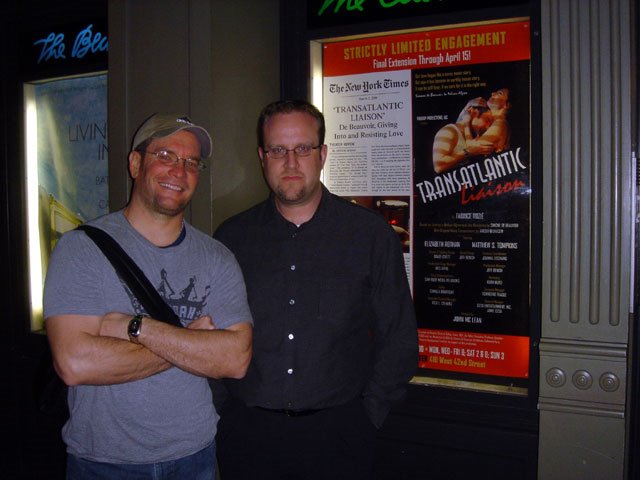
Theater Row on 42nd Street where Matt's show was.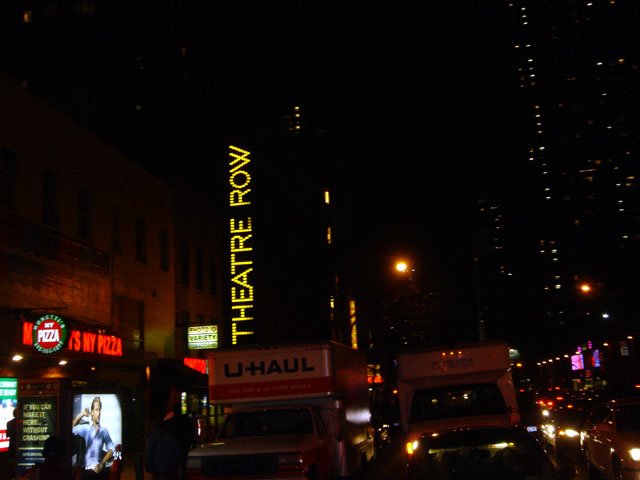
Great trip. If you haven't been to NYC in a while... go! They're indie film scene is good too.
-Blake
If you read my blog at all you know that this year I didn't get to see many of the Oscar nominated films. So now, I'm getting a chance to check some of them out - and the first one I decided to watch was the Oscar winning film for Best Picture - "Crash".
There was a lot of controversy when "Crash" beat out "Brokeback Mountain" (which I have not seen). A lot of folks said it was an anti-gay bias, or that they didn't want to hurt the "cowboy image" in Hollywood, or that the voters like the "LA" theme of "Crash". I don't know what they used as their rational, but I must say that "Crash" is not a Best Picture caliber film.
Before you read too much into that statement though, realize please, that I did like the movie. I thought it was engaging and entertaining. I just don't think it was a Best Picture. Was "Brokeback" better? Maybe. I don't know since I have yet to see it. Does it matter now? Not really. What does matter is that the Oscars continue to be (and always have been) a popularity contest (and political - not D.C. politics though, but Hollywood politics) so it's no surprise that they picked a sub par winner again this year.
Several other blogs have started lists of the worst Best Picture winners. It's pretty interesting really. Do I think "Crash" falls into a "worst" category. No. But I do think in years to come it will be regarded like perhaps "Shakespeare In Love", or "The English Patient". Good films that are only interesting to watch once.
I'm not going to give an in-depth review of the film. If you want that go check out Roger Ebert or the plethora of other "real" critics that have chimed in on the movie. What I will say is that it was well acted, well crafted (I liked the structure and editing style), but the script I couldn't quite figure out.
SPOILERS AHEAD...
Are we really suppose to believe that ALL these people are racists in one way or another? Or was Paul Haggis (the writer/director) giving us a "hyper real" look at racism in LA today? It's hard to tell, but I must believe it's the latter of the two.
I personally just found some of the stereotypes stupid...
1. The racist cop
2. The "Arab" store owner (although they weren't actually Arab)
3. The Mexican locksmith
4. The Chinese man smuggling immigrants
5. The Black car thieves
6. The White district attorney and his wife
Of course they all "worked" in this story. But, again, I wasn't sure if we're suppose to BELIEVE they are real or caricatures of people???
I liked several story lines better than others (Terrence Howard's for instance), and I did like how they all came together in the end a la "Pulp Fiction" or even a better analogy would be "Magnolia" (which for my money is a FAR superior film).
All in all "Crash" is an interesting movie and definitely worth checking out. I applaud the filmmakers for doing it on such a low budget (although it costs $7 million which to me is a HUGE budget - and it must be nice to have "friends" in high places to cast the likes of Sandra Bullock, Brendan Fraser, Matt Dillion, Terrence Howard, Don Cheadle, etc. - not exactly an "indie film" in my book).
Now we can all just look forward to next year to see what "popular" film will take the Oscar gold.
-Blake
Just got this from my entertainment attorney Mark Litwak...
INTERNET DOWNLOADS OF MOVIES BEGUN
Internet movie services Movielink and rival CinemaNow have begun to provide permanent downloads of movies from major studios on the same day the titles are released on DVD.
Movielink offers titles from Universal, Warner Bros., MGM, Sony, 20th Century Fox and Paramount. Sony, MGM and Lionsgate offer their titles through CinemaNow.
Downloads will cost about the same as the price of a DVD with older releases selling at a reduced price.
Movielink and CinemaNow beat out Apple, Amazon and Google to become the first to offer permanent digital downloads in the U.S.
Movielink's service includes recent releases such as Pride & Prejudice, King Kong and Rent. CinemaNow will launch with 75 films from Sony and MGM, including Memoirs of a Geisha, Bad Boys 2 and Easy Rider. With Movielink, users can transfer download copies to two other computers and burn a backup copy on a DVD. But the DVD will only be playable on a computer and not on a set-top DVD player.
Both services use Microsoft Windows digital rights management technology.
Knew this would happen soon with HD-DVDs right on the horizon. This is just the FIRST step, but a very important one. Soon enough, this will be the norm. The days of renting movies from Blockbuster will come to an end in the not too distant future I predict...
-Blake
Patrick Goldstien of the LA Times has a really good article (I think you have to register to read it, but not sure) on Hollywood and it's slow reaction to change (i.e. technology)...
Unfortunately, when it comes to embracing new technology, most people in showbiz are in deep denial. In his recent state of the industry speech at ShoWest, Motion Picture Assn. of America chief Dan Glickman offered the tired bromide of a "Got Milk"-style campaign to promote theater attendance. National Assn. of Theater Owners chief John Fithian gloated over the failure of "misguided experiments" in same-day release of movies on DVD and in theaters.
But perhaps the worst combination of denial and hypocrisy was on display at the Oscars, when Academy President Sid Ganis touted the theater experience, saying, "I bet you that none of the artists nominated tonight have ever finished a shot in a movie, stood back and said, 'That's going to look great on DVD.' " Ganis is a genuinely decent man, but it's hard to imagine a more egregious instance of Hollywood's "Do as I say, not as I do" elitism. No institution has more fiercely protected its right to watch movies on DVD than the academy, whose members are treated to Oscar screeners every holiday season, while we get a lecture about how we should settle for endless pre-show ads and overpriced popcorn.
I've talked about this on many ocassions and agree with Goldstien's premise from the article and that is - You've got to embrace the future.
Like it or not, this is a generation trained to access media when and how it wants it, not when it best fits the studio's profit picture.
Good read.
-Blake
TIME.com has some good comments from Steven Speilberg on current digital cinema trends and what he believes the future holds for film. A few notable blurbs...
"I'm too nostalgic to make my movies digitally. I'm the last person in Hollywood who cuts his film on film. I still love cutting on film."
"I think someday, when digital technology mainstreams, films will be broadcast to satellites from one transmission depot and then be beamed down into thousands of venues, which will save hundreds of millions of dollars when you combine every studio that releases movies on film, that have to pay those laboratory costs. "
"Audience members are only concerned about the story, the concept, the bells and whistles and the noise that a popular film starts to make even before it's popular. So audiences will not be drawn to the technology; they'll be drawn to the story. And I hope it always remains that way."
"I have to go on record saying that I am not in favor of a DVD coming out the same day as the film opens, because I really believe that the average home system is far inferior to a movie house. And a lot of it is the social magic of going out to the movies, seeing it with a lot of people you have never met and sharing an experience. I feel there is no substitute for going out to the movies. There is nothing like it. "
I had no idea he still CUTS HIS MOVIES ON FILM USING A FLATBED. That is completely unbelievable to me that one of the greatest filmmakers of our time has not embraced digital non-linear editing. It's been around for over 10 years! And, once you edit that way you'll never go back. This is of course one of the reasons why I think Hollywood is being so slow to adapt to new technology... they're afraid and/or just too used to doing it the "same old way".
Read the entire TIME piece by clicking here.
-Blake
MSNBC picked up on the "Shoot J.R. In Dallas" campaign - now if just Twentieth Century Fox will...
http://www.msnbc.msn.com/id/11904069/site/newsweek/
-Blake
While I'm not necessarily interested in re-mixing the movie trailer of "Top Gun" into "Brokeback Gun" (although that could be funny - have you seen "Brokeback To The Future"? Very funny stuff at YouTube) - I am interested in the ever-growing online community's appetite for video content. With places like YouTube and Google Video among others, the sheer number of folks out there watching stuff is honestly unbelievable.
At the IndieWire blog I found a good article, here are a few excerpts that caught my eye...
YouTube serves 30 million videos a day. Three-thousand files are uploaded daily. They have 5 million unique users per day, and, according to Nielsen/NetRatings, they had 9 million unique users for the month of February.
Is that not crazy? Can you imagine the exposure for content on YouTube? Evidently Dimension Films has...
...Dimension Films have begun to upload trailers and commercials. Currently, Scary Movie 4's trailer has been seen 369,142 times in the three days since it's been up, so it appears that the Weinstein Co. is reaching its target audience.
I've been playing with the idea of posting the "Killing Down" trailer on YouTube and after reading this I'm thinking, why not?
Read the entire article by Jerry Weinstein, it's definitely interesting.
-Blake
Ann Thompson from the Hollywood Reporter has an article on the "success" of "Bubble" with it's day-and-date release strategy and also "Waterborne" - the first movie release via Google Video.
It depends on who you talk to as to whether either were a success or not. I personally think they both were if not only from an awareness and informational point-of-view (and also them being the guinea pigs).
Looks like "Waterborne" got screwed by some calculating error on Google's part (ehhhh, yeah, sounds familiar - like what you'd hear from "regular" distributors). So, it didn't do that much business - although not bad for an unknown movie.
And I have stated before that the main reason "Bubble" didn't do more business was because it was not a good movie. In the end, that's all that matters no matter how you're distributing the film...
Check out the article:
http://www.hollywoodreporter.com/thr/columns/risky_business.jsp
-Blake
Mark Cuban has several new articles on his blog that are worth reading.
The first one is on the future of TV on the Internet - a subject I'm very interested in. He believes one day the Internet will be they way we watch TV, but not anytime soon. Why? Because of bandwidth...
http://www.blogmaverick.com/entry/1234000173073592/
Another good piece is on Digital Rights Management (i.e. copy protection such as Apple uses with iTunes, etc.). He actually suggests cracking the DRM and making back-ups of the files so they will play in the future...
http://www.blogmaverick.com/entry/1234000850073598/
And lastly, he has a nice piece on "Success & Motivation" that is not directly related to filmmaking or distribution - but it is about running your own business, which a lot of us (filmmakers) do...
http://www.blogmaverick.com/entry/1234000527073594/
Now I'm going to try and dry out for a while. If you've seen the news over the past day or so (or if you live in north Texas - Dallas specifically) we got drenched in rain. I got trapped over by White Rock Lake in east Dallas and couldn't get home. All the low lying areas were flooded. Cars were swamped. Some places had up to 7 or 8 feet of water. At least one lady drowned.
I ended up spending about 2 hours sitting in a Chilli's waiting out the storm (and the rain really never stopped until today). The drive home after that wasn't so bad - but of course I had increased my courage with 3 scooners of beer. :)
-Blake
"Can This Man Save The Movies? (Again?)" is an excellent article from TIME magazine featuring George Lucas and other prominient filmmakers arguing both sides of the future of digital cinema...
Here's a magic glimpse into the future of movies. A big blockbuster opens. Some people see it in sparkling digital clarity on wraparound screens in ultraswank theaters; others watch the same movie the same day on an 8-ft.-wide screen in their home media center; still others get it transmitted instantly through their computer, iPod or cell phone. It's a looking-glass scenario that could happen in a future near you--if the people who finance and exhibit Hollywood movies want it to.
We are at the bright dawn of the movies' digital age, but the Hollywood establishment still has its shades drawn. In the Oscar show at the Kodak Theatre (named after a company that is crucially invested in the film-stock status quo), the most popular live-action digital movie in history, George Lucas' Star Wars: Episode III--Revenge of the Sith, won no awards, not even one for technical achievement. The year's boldest, most innovative digital experiment, Robert Rodriguez and Frank Miller's Sin City, got no nominations at all.
The Oscar revelers seemed unaware that movies have two big problems: the way they're made and the way they're shown.
This is just a small taste of the article. Definitely read it if you're interested in this topic at all. It's really, really well done and very informative.
-Blake
 This is the title of a new book coming out end of this month that is being praised (pun intended) as the "New Indie Bible".
From Amazon's description:
The explosion of independent cinema over the past fifteen years has created thousands of would-be filmmakers, all dreaming of becoming the next Quentin Tarantino or Steven Soderbergh—and all working away like beavers, making thousands of independent films. But what do they do once the movie is made? In I Wake Up Screening, powerhouse authors John Anderson and Laura Kim tell emerging filmmakers how to (and how not to) get their movies talked about, written about, sold, and seen. The authors’ advice is supported by insightful interviews with more than sixty top industry insiders, all offering priceless behind-the-scenes tips and tricks. Making a film isn’t the end anymore—it’s only the beginning. I Wake Up Screening can make the difference between a movie that gets into theaters and one that ends up on the floor of the director’s bedroom closet.
About the authors:
John Anderson, chief film critic at Newsday, is a past member of the selection committee of the New York Film Festival as well as a member and two-time past chair of the New York Film Critics Circle, a member of the National Society of Film Critics, and a member of the National Book Critics Circle.
Laura Kim is the executive vice president of marketing and publicity for Warner Independent Films. Previously the senior vice president for the publicity firm mPRm, she has worked on such films as American Splendor, Dirty Pretty Things, The Pianist, Being John Malkovich, March of the Penguins, and Good Night and Good Luck.
You can pre-order it on Amazon.com or I actually found it cheaper on OverStock.com.
Sounds pretty promising. I actually just pre-ordered a copy for myself!
-Blake
From a press release:
ClickStar, Inc., a digital entertainment venture founded by Revelations Entertainment, the production company headed by Morgan Freeman and business partner Lori McCreary, with investment from Intel Corporation, will release its first feature film, "10 Items Or Less", starring Morgan Freeman and Paz Vega ("Spanglish").
This precedent-setting effort addresses growing consumer desire for premium entertainment and marks the anticipated launch of the ClickStar broadband entertainment service later this year.
The A-list film will debut on ClickStar within weeks of its national theatrical release.
ClickStar's core mission is to become the online destination for premium content, designed to give filmmakers a vehicle to connect directly to their fans with new ways of experiencing home entertainment in a very affordable and flexible way. ClickStar's service plans to offer first-run, pre-DVD-release films and artist-created entertainment channels as part of its online services. ClickStar's service will target millions of broadband consumers worldwide using Intel® Viiv technology-based PCs.
Typical ClickStar users will be able to enjoy full screen high-fidelity films conveniently on their big screen TV from the comfort of their homes or on-the-go through laptop PCs.
Intel President and CEO Paul Otellini made the announcement during his afternoon keynote at the 2006 Consumer Electronic Show. As a strong endorsement for this ground breaking service, Otellini, Freeman and ClickStar Chairman Lori McCreary were joined by Hollywood filmmakers Danny DeVito, Tom Shadyac, Tom Hanks and Brad Silberling.
"The announcement of "10 Items or Less" and the plan to deliver it through the broadband into the living room just weeks after the movie's theatrical release marks a key milestone in the vision we outlined just two short years ago at CES", said Otellini. "We are excited to bring this vision to reality, and even more committed to making premium, first-run content available to consumers in the comfort of their own digital home theaters."
Freeman said, "Our collaboration with Intel continues to grow, and ClickStar with Viiv technology offers a huge opportunity for filmmakers to reach audiences worldwide. With "10 items or less" and ClickStar's service, we can now offer film fans a choice - watch it in the theatre or anytime they want in the comfort of their home."
Brad Silberling said, "For those who won't make it to a movie theater, it's a chance to enjoy a uniquely intimate viewing experience - an experience that's as intimate as the story itself."
"10 Items or Less" is a co-production between Reveal Entertainment and Revelations Entertainment and will be produced by McCreary, Silberling and Julie Lynn. The film begins shooting next month in Los Angeles (it is shooting now).
Go to ClickStar's website to watch a short video featuring Morgan Freeman (it's on the upper right hand side of the page). He talks about the vision of ClickStar.
It's interesting because he speaks of legal movie downloads as combating piracy and compares the film side of things to the music industry (and how they screwed up until iTunes came along) - and he makes some very good points.
This info came out in January, but I hadn't followed it much until recently. I'm looking forward to seeing how it all plays out.
-Blake
This is a continuation of my previous entry on Digital Cinema - only this is kind of the opposite.
Scott Kirshner (from CinemaTech) has written an article for the Boston Globe entitled "Downloads Enter Hollywood's Mainstream" where he talks about all the various entities either currently utilizing Internet movie downloads or ones that are going to be doing them soon. It's a nice article...
The idea of digital delivery is starting to gain momentum, as studios make more of their movies available to Internet download services like CinemaNow, Movielink, and Vongo. Two other big players could jump in, too. AppleInsider.com, says the company may be considering adding movies to its iTunes Music Store, and last week Amazon.com was reported to be in talks with Universal, Paramount, and Warner Bros. about offering their movies on the site. Moviebeam, a start-up funded by Disney, Cisco Systems, and Intel, started selling a set-top box earlier this year that can store 100 new releases, and will soon support delivery of movies over the Net.
He also talks about Morgan Freeman's new movie "10 Items or Less" that will be released theatrically and via Internet download (produced by Clickstar and Intel).
-Blake
As the movie theater industry's annual convention kicks off Monday in Las Vegas, the conversion to digital cinema is again on the agenda.
But this year, instead of more talk about digital's promising future, there actually will be an opportunity to assess its practical, real-world applications at ShoWest.
With technical specifications in hand, business models under development, studios coming aboard and theater circuits making plans, 2006 is shaping up as the year digital cinema finally is ready for its close-up. Just don't expect the rollout to take place overnight.
"After years of planning, developing technical specifications and considering business models, the digital-cinema revolution begins in 2006," said John Fithian, president of the National Assn. of Theater Owners. "All of those three components have come together, and deals are being negotiated now between theater companies and equipment and financial entities. It will take several years for this transition to occur, but 2006 certainly marks the beginning of the transition."
This is from a good article at ZDNet (thanks to my step-brother Matt for sending me the link). I'm very glad to see major theater chains and the major studios moving forward with this (they've got to do something to improve the theater experience, and this is a good start). The only people I'm sure that don't like this progress are the folks at Kodak.
Sorry Kodak, but, the times they are a changin'...
http://news.zdnet.com/2100-9584_22-6048828.html?tag=zdfd.newsfeed
Very informative piece. Definitely take a moment to check it out.
-Blake
 Unfortunately, I didn't get to go to SXSW this year (fest is currently happening), although I might make a one-day trip to Austin on Tuesday for an unrelated gig (possibly shooting an interview down there).
Anyway, for some really good reporting from the panels and a few film reviews you need to check out Mike Curtis' blog at www.hdforindies.com. He's posting some great stuff!
A couple of the highlights for me are notes he took on a distribution panel with Todd Wagner (and all his cronies at Landmark, 2929 Entertainment, Magnolia Pictures, etc.) and another panel discussion with Peter Bart the editor of Variety.
SXSW has steadily grown over the past few years to be one of the definite top tier film festivals in the USA. I'd say it's getting very close to Sundance prowess now - although not quite as prestigious (or pretentious) and not as many "deals" made with distributors - but it is a really good festival.
I'm going next year for sure with or without a project to promote.
-Blake
Some are claiming that HDV is to DV what DV was to Beta SP. In other words, a cheaper, yet (sometimes) better acquisition format. I'm not sure I agree... just yet.
HDV has been around for about two years or so with different flavors from different vendors popping up all over the place. JVC was really the first player with their one-chip consumer HDV camera - then Sony came on board with their consumer three-chip camera - shortly followed by their prosumer camera. Since then pretty much everyone has an HDV camera on the market, except for Panasonic who doesn't buy into the HDV codec scheme of "inter-frame" compression (they're new offering is DVCProHD, which is "real" HD just like the Varicam shoots).
I have shot with the new JVC HDV camera and really liked how the camera felt - it was like a "mini-Betacam" or similar feeling camera. It rested well on your shoulder for excellent ENG or documentary style shooting - unlike the other "handycam" style cameras that make your arm tired, etc...
So, what does this have to do with my first HDV editing gig?
Well, besides giving you a little background on the format, and telling you my limited experience with it - I wanted to mention how I really liked the JVC camera and compare that to their HDV deck, which I now have decided I HATE.
The deck basically doesn't work with Avid (my editing platform of choice). Not sure about Final Cut Pro or other NLEs, but it does not like the Avid.
We tried capturing into Xpress Pro and into an Adrenaline - no luck with either system. We can see the footage and play the footage into the system for a moment or two, then the deck stops. We also have no deck control either via Firewire or RS-422. We even tried capturing the footage into an Adrenaline through a Miranda converting the HDV signal to HD - making the footage go through the HD-SDI connection, and still had no luck.
We definitely think it is a JVC issue and not an Avid one - although I have said all along that HDV shooting is far ahead of the software to edit it on. HDV is just MPEG 2 video. This format was not created as an acquisition format. It's what DVDs use. It's what many broadcasters use to transmit their TV signal. It really is NOT a good format to shoot with. BUT, it is cheap and looks pretty darn good, actually far better than it has any right to. So, it's going to be around a while (although tape is rapidly disappearing, which would help with our capture problems!).
The only way we could get the JVC HDV footage into the Avid was via the CAMERA. And I hate capturing from a camera for several reasons, but mainly because it's bad on the heads. We also couldn't batch capture from the camera (and again, you wouldn't want to really anyway). But the worst thing was if you captured more than a four or so minute long clip the audio would slowly slip out of synch. This sucks! We found this out the hard way and had to recapture two entire hour long tapes - then the audio actually slipped again on some of the new clips. So, instead of capturing that again, I simply synched them by hand. That sucked too!
I don't have any real experience with the Sony or Canon 1080i flavor of HDV and capturing. But, I have used the Sony deck and it "talks" to the Avid nicely. Why didn't we use it? Well, the JVC camera shoots 720p and the Sony deck will play it back, but only through the analog component outputs - NOT the Firewire port.
The producer of this project is probably going to return the JVC deck. What he ended up doing was renting a Panasonic HD deck - transferring the HDV tapes with timecode to it - then editing the show in true HD in the Adrenaline. Bad thing is there were 40 HDV tapes at an hour each to dub! This not only took a long time to do, but it costs a ton for tapestock and deck rental.
I hope to see some software upgrades at NAB this year for all platforms editing HDV. I gotta believe it can be done, but with my experience it's just not quite there yet.
So, just beware before you jump head first into a project or make a purchase of any HDV gear - or really any new gear period. I can't stress enough to test, test, test (thank goodness none of this project was on my dime).
I tell ya, the good ole' days of Betacam don't sound so bad to me right now.
-Blake
Last Thursday I did the first of several ADR sessions with the actors that we need to replace or add dialogue with. For you non-filmmakers this is also called "looping".
The actor watches a screen with the edited scene on it and hears via headphones the original dialogue - then it's played back again, only this time three "pops" are heard and where the fourth would fall they say their lines.
It can be a tedious process I assure you. Especially when the dialogue is on-camera and not off. Off-camera stuff is fairly easy, but the on-camera not only needs to sound the same - but it has to sync with the original. There is software that helps with this (it actually manipulates the wave form to match the original), but it's best to get it as close as possible, then rely on the software.
Why are we doing this? For three main reasons:
1. We're replacing dialogue that was too "noisy" or was recorded too low or off-mic (sometimes a plane might fly over when shooting or an actor turns away from the mic).
2. We are adding some dialogue to make scenes play better. This is done a lot - you add a line from a character who is off-camera to help push the narrative or explain something.
3. We are also doing a "TV version" for future distribution, so anytime there is profanity we're replacing it with a "safe" word. This is challenging too because a descent chunk of the dialogue is in Spanish (and I don't know a cuss word from a friendly salutation). Luckily our ADR team (and all the sound team really) is fluent in Spanish.
Again, this is tough work and often you don't get the exact same performance - which can suck - but nothing is worse than hearing noisy ambience in the background or having ambient changes between cuts of two characters talking.
On the flip side though, sometimes you can improve (or change) an actor's performance by having them loop some lines. I've found sometimes something you thought sounded good on set doesn't sound so good in the dark editing suite - so you have them do some looping.
On the music side of things, I've listened to cues from most of the first two reels - and it's sounding great. Our composer really has a feel for the movie and the stylized sounds we need for the narrative. The music is also directly related to the sound design. They are both critical elements to the story - much more so than any other film I've done so far. When you see the finished film you'll understand (and I hope you get to see it).
Speaking of seeing the film... I hope to have a date soon for the premiere in Dallas. Still working out a few details, but I'll post info as soon as it's firm.
I just hope we get everything done in time for the Cannes film market in May...
-Blake
 The "Shoot JR in Dallas" Campaign kicked off today at Dallas City Hall - March 8, 2006
Dallas Convention and Visitors Bureau President and CEO, Phillip Jones, Dallas Mayor Laura Miller and Dallas Film Commission Director, Janis Burklund announced the new "Shoot JR in Dallas" campaign to help raise funds for the DFW Production Fund today at City Hall.
The grassroots movement will help create private support in hopes to attract more television and film projects to the area, starting off with the upcoming "Dallas" feature film. In attendance and showing their support were numerous city councilmembers, City Manager, Mary Suhm and other city officials.
Check out the merchandise and see how you can help! Go the website at www.filmdfw.com and click on "Shoot JR in Dallas" on the home page.
The film commission is constantly being asked by supporters "How can we help?"
Here's how!
- Help us spread the word.
- Purchase "Shoot JR in Dallas!" bumper stickers, hats and t-shirts for a nominal charge on our website www.filmdfw.com. The money raised will be applied toward the DFW Production Incentive Fund.
- In addition, a donation form is provided on the site.
- It won't take the place of state funding - that's critical to our short-term and long-term success. But it will help. And grassroots support is very important for visibility of the cause.
My thoughts...
I'm glad to see the City of Dallas working in conjunction with the Dallas Film Commission. Our state leaders have really dropped the ball in recent years on creating incentives for movies (especially big Hollywood ones) to shoot in Texas.
If you didn't know, there is talk about shooting the new "Dallas" movie IN CANADA. Yeah, that's right. Can you imagine JR and Bobby drinking Molson??? I hope this campaign helps!
-Blake
I have proof that Mike Curtis is actually living (Who is Mike Curtis you ask? He is the blogger from HD for Indies that has been M.I.A. for about three weeks or more. Some readers at his blog were just about to send out a search party...). :)
He posted a comment on the FresHDV blog yesterday! I just read it this morning. Evidently he's been buried in a job for a film that is premiering at SXSW this Sunday. No word on what the film is called, but it sounds like it was shot on Mini DV and he did an HD uprez, etc. on it.
I'll look forward to hearing about the project soon, because Mike says he'll be back to blogging in the near future (my guess is after SXSW). Very cool. I'm glad he's coming back.
-Blake
And here's another player in the new world of Internet VoD... this time it's a fairly small, unknown company called AOL. Maybe you've heard of them?
http://money.cnn.com/2006/03/03/technology/aol.reut/?cnn=yes
-Blake